
Content Library
A year of content, captured in days.For teams who publish constantly and are permanently short of material to publish with.
From £3,000, most libraries between £6,500 and £10,500.
Does this sound like you?
You may recognise yourself in one of these:
Always Short of Assets
A team that has to publish every week and is always hunting for something to publish with
Reusing the Same Six Photos
The same handful of images across every channel, and everyone has noticed
A Folder Nobody Opens
Rushes from a previous production sitting on a drive because nobody can edit them
A Moment You Can Only Capture Once
An event, a season, a build or a programme that will not look like this again
In-house and Under-resourced
A capable marketing team with no capacity for a shoot and no budget for one per campaign
A Rebrand That Broke Everything
New identity, new messaging, and a back catalogue that no longer matches any of it
What a content library is
A content library is a bank of finished, catalogued video and photography, captured across one to three production days and curated so your team can publish from it without a professional editor or editing suite.
Where a flagship film tells one story properly, a content library gives your team the material to tell a hundred small ones. We often can include a content library as part of your project leveraging the production investment across both deliverables.
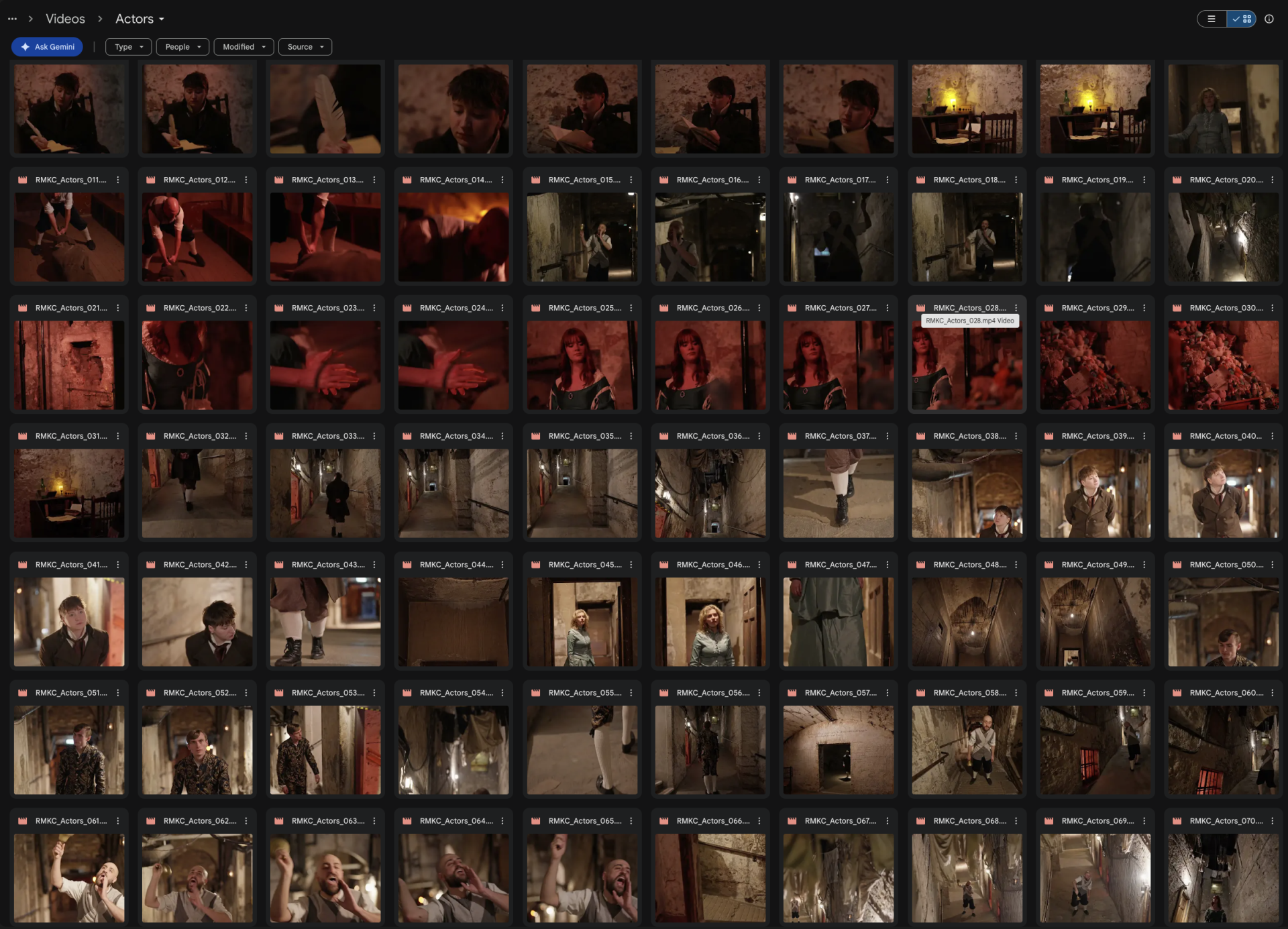
Every clip is cut, graded and named. Photography is shot alongside by a photographer rather than pulled from video. Everything arrives in the ratios you actually publish in, organised so someone can find what they need in seconds rather than scrubbing through footage.
It is built for people who post a lot, and for people who edit a little.
“Impressively efficient and organised.“
Emilie Lumineau, Marketing Manager, The Real Mary King’s Close
Why not just ask for the rushes?
Because rushes are not content. They are the raw material content gets made from, and making it needs a skilled editor, specialist software and hardware that can handle the files.
Most teams asking for rushes are picturing something they can drop straight into a post. What actually arrives is hours of unusable footage. Four minute takes, unstable sections, no grade, no sound balance, and file sizes and formats that will not open on an average laptop.
A content library is already made for social, ready to drag and drop into whatever editing app your team already uses.
Every clip is trimmed to a usable length, colour graded, named for what it contains and exported in the ratios you publish in. Your team opens the folder, finds the thing, and posts it. No software, no skills gap, no waiting on us.
That is the difference, and it is why a library usually costs less than the raw footage add-on while being considerably more useful.
What you get
Every content library engagement delivers:
Finished clips. Trimmed, graded and sound balanced, in a range of lengths, ready to publish without further editing.
Professional photography. Shot alongside the video by a photographer working to the same brief, not frame grabs. Ready for web, press, decks and reports.
A catalogue, not a folder. Everything named for what it contains and grouped by subject, so your team finds things without scrubbing.
The ratios you actually use. Widescreen, square and vertical as standard, rather than one master everyone has to crop themselves.
Delivery your team can work from. Structured, searchable, and sized to open on a normal laptop.
Depending on the shape of the project, engagements often also include a short content plan mapping assets to what you publish, captioned versions of key clips, studio capture alongside location days, and a simple usage guide so the library gets used rather than forgotten.
Investment
.
.
Focused
£3,000 to £5,500 + VAT
One production day, one location.
For a single site, event or subject, captured against a content plan agreed beforehand. One day with a small crew, video and photography together.
You receive the catalogued clip library, professional photography, all three aspect ratios, and one selects review before finishing.
Right when you need a solid bank of material for a specific channel or campaign and know roughly what you want in it.
.
Most projects sit here
Extended
£5,500 to £10,500 + VAT
Two to three production days, multiple locations or subjects.
For campaigns, multi-site organisations, events across several days, or a library intended to cover a full year of publishing.
You receive a substantially larger catalogued library across multiple subjects, a full photography set, all aspect ratios, a content plan mapping assets to channels, and one selects review before finishing.
Right when the library has to carry your publishing for months rather than weeks.
.
Year-Round
£10,500 to £18,500 + VAT
Capture across the year, in planned blocks.
For organisations whose content dates seasonally, whose sites and programmes change through the year, or who want the library refreshed rather than replaced. Capture happens in scheduled blocks across twelve months, each planned against what you are publishing next.
You receive everything in Extended, delivered across four capture points, with the catalogue building rather than starting again each time.
Right when publishing is continuous and a single capture will look dated by spring.
A note on how the range works:
The lower figure is the working budget. It is what the project is scoped against and what is delivered for certain. The upper figure is the approved ceiling, the level you have authorised the project to reach if scope grows during delivery. Nothing is drawn down above the working budget without a written Change Request from us and written approval from you.
“Working with FoSho on our new video material has been an absolute pleasure. From start to finish, they made the entire process incredibly smooth and stress-free. The team adapted seamlessly to this constraint, showcasing their flexibility and professionalism.“
Emilie Lumineau, Marketing Manager
The Real Mary King’s Close
Efficiency in motion
Adding a content library to a project we’re already delivering costs 30-50% less!
The expensive part is in the preparation, planning and getting crew, kit and production access into position. Once that is done, capturing more is comparatively cheap, and we would rather you had the benefit of that now.
Flagship Narrative
Brand · Launch · Campaign
The one film everything else sits under.
From £3,500
For a launch, a strategy, a place or an organisation that needs one story told properly, and a set of assets that all agree with each other.
Impact Film
Programme · Funder · Legacy
Proof of what you did, told by the people involved.
From £3,000
For programmes, services and partnerships that achieved something real and need it on record, for funders and for the public.
Documentary
Story · Legacy · Anniversary
A story worth telling, that happens to be yours.
From £4,500
For organisations with a story bigger than themselves. When founders, pioneers, movements and milestones need narrative driven, authentic storytelling.

How long it takes
Most content libraries run four to six weeks from signed engagement to delivery. Considerably faster than our other formats, because there is no narrative to develop and no edit to approve. Year-Round engagements follow the same rhythm at each capture point across the twelve months.
Content plan
What you publish, what you are short of, what we capture.
Production
One to three production days, scheduled around your access.
Post-production
Cut, grade, catalogue. Selects review with you partway through.
Delivery
Structured, named and ready to use.
Working to a campaign launch or a seasonal window? Say so on the call. We plan backwards from your date.
How delivery works
Four steps rather than five. This format genuinely has fewer.
One: Content plan
We start with what you actually publish. Which channels, what formats, what you are always short of, and what you have coming up. That becomes a capture list, so the shoot has a target rather than a hope.
Two: Production
One to three production days, scheduled around your access rather than ours. Video and photography together. We shoot wide enough that material works across ratios rather than being locked to one.
Three: Post-production
We cut, grade and balance the material, then share the selects for you to review before finishing. This is the only review point, and it is deliberately early.
Four: Catalogue and delivery
Everything named, grouped by subject and exported in every ratio you use, delivered in a structure your team can search.
A library nobody uses is just storage
The failure mode for this format is not bad footage. It is four hundred good clips in a folder nobody ever opens.
It happens because material arrives named A001_C0034 and organised by camera card. That makes sense to us and is useless to someone with forty minutes to get a post out. They open it once, cannot find anything, and go back to the same six photos they were using before.
So the catalogue is the product, not the by-product.
Clips are named for what is in them. Everything is grouped by subject rather than by shoot day. Every asset exists in the ratios you publish in, so nobody has to crop anything. And it is sized to open on a normal laptop rather than an edit suite.
We would rather deliver two hundred assets that get used than four hundred that do not.
Content library work we have delivered
Content Libraries we have made for organisations across science and innovation, education, consumer brands, tourism and hospitality, and the public sector.


What we need from you
For a content library to be worth having, a few things need to be true on your side:
- Someone who owns it after delivery. This matters more than anything else on this list
- A sense of what you publish and what you are always short of, even roughly
- Access to the locations, people, products or activity worth capturing
- Consent for anyone appearing, particularly participants and members of the public
- Brand guidelines, and the aspect ratios you actually use
On the first one. Libraries fail when nobody owns them. If the person commissioning is not the person publishing, introduce us to whoever is, before the content plan rather than after delivery. Ten minutes with them shapes what we capture more than anything else does.
Frequently Asked Questions:
How much does a documentary cost?
Content libraries start at £3,000 and most sit between £5,500 and £10,500 plus VAT. Year-round capture across four planned blocks runs from £10,500 to £18,500. Added to a production we are already delivering, a library costs 30 to 50 per cent less.
How long does it take?
Four to six weeks from signed engagement to delivery. It is the fastest of our formats, because there is no narrative to develop and no edit to approve.
How is this different from just getting the raw footage?
Rushes need a skilled editor, specialist software and hardware that can handle large files. A content library is already finished. Every clip is trimmed, graded, named and exported in the ratios you publish in, so your team can use it immediately.
Can we book photography on its own?
We can but often photography is part of a content library rather than a separate booking. Shooting stills alongside video on the same day gives you considerably more for the same access, and the photography arrives catalogued alongside everything else. If photography is genuinely all you need, tell us on the call and we will be straight about whether we are the right fit.
How many assets do we get?
We agree a target at content plan stage, based on what you publish and what you need. We would rather deliver two hundred assets your team actually uses than four hundred nobody can find.
Can our team edit these themselves?
They will not need to. Everything arrives ready to publish. If your team does want to combine clips or add text, the files are sized and formatted to work in the tools most marketing teams already have. Smartphone or Desktop, these clips are ready to edit with the most basic of tools and skills.
Do we own the content?
You receive full usage rights to the delivered library once commercial terms are met. Original camera files remain FoSho property and are available as an optional add on at a standardised rate, though the library is designed so you should not need them.
Can we do this alongside a film?
Yes, and it is the most efficient way to buy it. If we are already delivering a Flagship, Impact, Documentary or Animation project, a library added to that production costs 30 to 50 per cent less than commissioning it separately.
What is not included?
Media spend and distribution, bespoke edits assembled from the library, and original camera files. Anything outside the agreed content plan is handled as a documented Change Request with its own fee, agreed before work begins.
Do you work outside Glasgow?
Yes. We are Glasgow based and work across Scotland and the UK. Travel and accommodation for locations outside the central belt are factored into the range. Global travel can also be accommodated in the higher investments and above.
Next step
If the range works, here is exactly what happens.
One. A twenty minute call. We establish what you publish, what you are short of, and when you need it. We do not scope or price on the call.
Two. We confirm your tier and send a Project Engagement Form.
Three. You sign, we invoice the deposit, and your dates are held.
Four. The content plan starts. Everything from that point is paid work rather than a proposal.
Most engagements go from first call to signed engagement inside ten working days.
Book a call