
Why Charities Need a Content Partner, Not Just a Film Crew
Charities rarely make content for one audience, and their strongest stories belong to the people they serve. Here is why that calls for a content partner rather than a film crew.
FoSho STUDIOS works with charities of every size, from national organisations to small local ones. That includes the British Heart Foundation since 2017 across all four UK nations, Parkinson’s UK, Resuscitation Council UK, the Poverty Alliance and the Living Wage Foundation, the Royal Zoological Society of Scotland, Glasgow and Clyde Rape Crisis and Glasgow Children’s Hospital Charity. Most of it is repeat work with the same teams, which is where everything below comes from.
TL;DR
- Charity content is asked to do several jobs at once: raise funds, inform policy, reassure patients, recruit volunteers and keep supporters close.
- The most powerful stories a charity can tell belong to the people it serves. They’re also the most delicate, and need time, trust and duty of care rather than a crew who arrives on the day.
- A crew for hire shoots what it’s briefed to shoot. It’s rarely still involved three projects later, so tone, quality and trust have to be rebuilt every time.
- Every recurring charity need maps to a format we already make, from campaign films to patient information animation.
- One well planned production day can produce a full campaign suite, which matters when every pound is scrutinised by trustees, funders, supporters and the press.
- The relationship compounds. The second and third films ask less of your team, because the structure, the approach and the trust already exist.
- A quick and simple way to get started. A 20-minute discovery call with our Studio Director, then a recommended format and investment range. Charities of every size are welcome.
The content problem most charities have
Charity marketing, communications and fundraising teams are rarely making content for one audience.
Supporters want to see what their money does. People using a service want to recognise themselves and feel reassured. Trusts and funders want evidence. Politicians want a reason to act. Volunteers and fundraisers want something worth sharing. Corporate partners want to be seen alongside the cause. Each of those is a different piece of content, and most charities end up commissioning them one at a time, against a deadline, from whoever is free.
Charity content is also rarely just awareness. It’s usually asked to change something. To get defibrillators registered. To build momentum behind a change in the law. To put a decision maker in the same room as the people a policy affects. To get someone to sign up for a fundraising ride.
Where a crew for hire runs out of road
A film crew will turn up and shoot what they’re briefed to shoot. That’s the service, and for some jobs it’s the right one.
For charities, the limitation shows up fastest around people. The strongest stories a charity has belong to the people it serves: a survivor, a carer, a family living with a wait. Those stories need preparation, consent that’s properly understood, and a team the contributor is comfortable with well before the camera comes out. A crew meeting them for the first time at the door can’t offer that, and is rarely still involved when the next campaign needs the same people again.
Everything else has to be rebuilt too. Brand guidelines, clinical sign-off, safeguarding, the approval route, and who in the organisation actually says yes. The in house team ends up managing suppliers when it should be making decisions.
What most charities need isn’t more suppliers. It’s one partner who already understands the organisation, carries that understanding from project to project, and is willing to say when a brief or a budget won’t do the job it’s meant to do.
Tried and tested content formats
We have developed a number of formats over the years to make it easy and effective to create content. It has a clear job, a structure we know works and a set of assets planned from the start. Starting from one means nobody is inventing a brief from scratch, and everyone who signs off, from the comms team to clinical and safeguarding leads, knows what they’re approving before filming begins.
Below are the six we make most often for charities, each matched to the job it does and a project that shows it in practice. Many campaigns combine two or more.
Flagship Narrative
Campaigns, advocacy and Parliament
A single focused film built to move people to act, whether that’s a supporter registering a defibrillator or a decision maker at a parliamentary reception. Usually cut into survivor stories, trailers and social edits from the same production.
Full Project: The Circuit, British Heart Foundation
Impact Film
Services and programmes that need proof
Built to show what a service actually changes, told by the people who take part, the people who run it and the people who care for them. The brief behind most funder reports, trust applications and service reviews.
Documentary
Legacy, heritage and the people behind the work
Built from contributors speaking in their own words, for audiences who discount anything that reads as marketing. Our documentary for BHF Scotland’s annual research lecture is now in its fourth year as a series, each film asking less of the team than the last.
Full Project: Legacy of a Pioneer, BHF Scotland
Animation
Patient information and public health
Explains a procedure, a process or an emergency that can’t or shouldn’t be filmed, clearly enough to reassure someone before an appointment. Built with the clinical teams who will stand behind it.
Full Project: Cardiac Care, British Heart Foundation
Educational Content
Public health education and community outreach
Built to teach something people may one day need to act on, in a form that can be shared, screened and reused for years. Voiced and subtitled so it reaches every community a charity serves, not only the ones already listening.
Full Project: Chain of Survival, Resuscitation Council UK
Content Library
Fundraising events and year round content
One production day captured properly, then cut into a flagship film, social reels and a library of graded clips the team can keep using on their own long after the event.
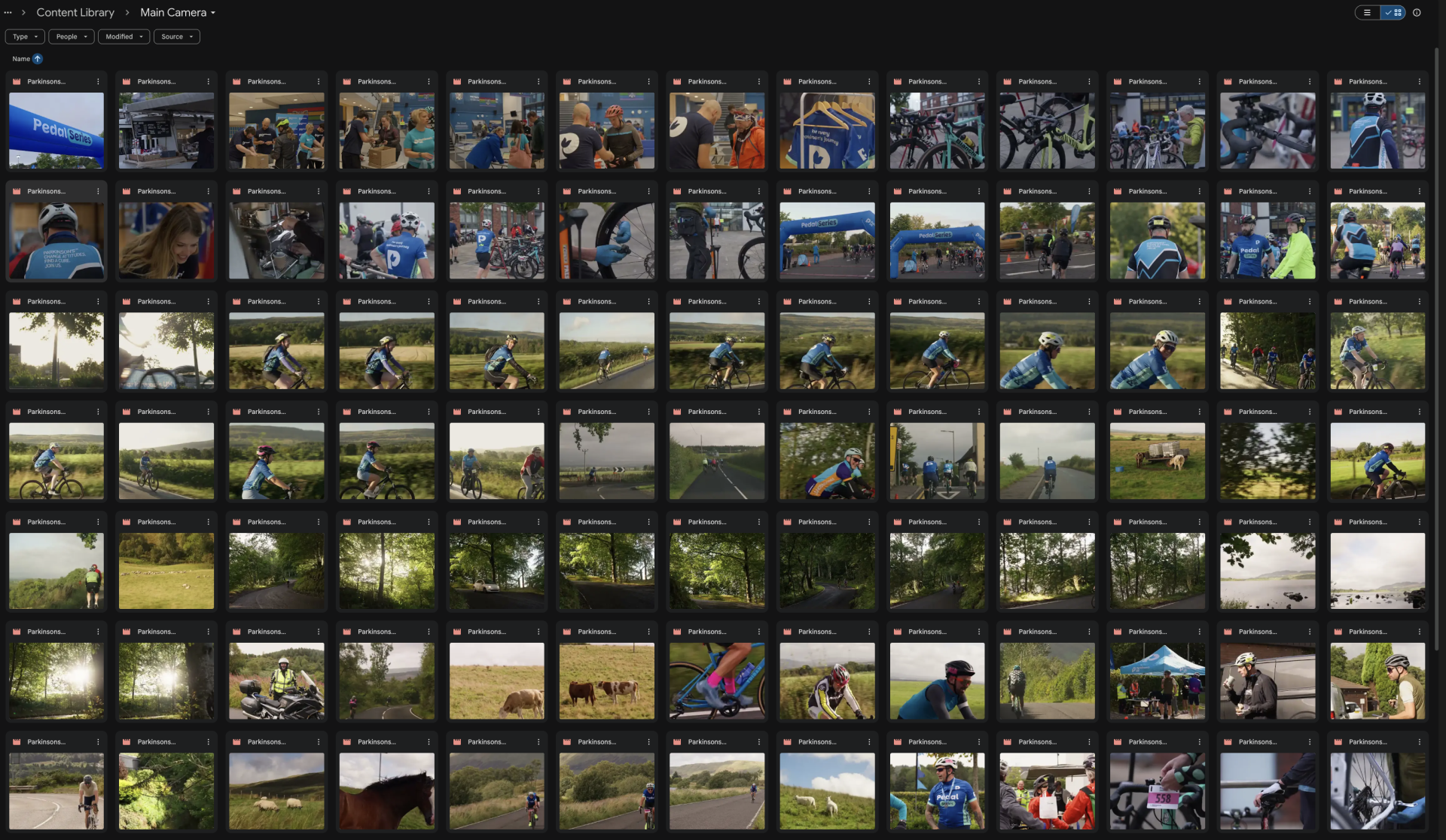
Full Project: Pedal Trossachs, Parkinson’s UK
Working around the constraints
The practical obstacles that make charity content feel challenging are production problems, and production problems have solutions. Lived experience is the first, and the one that matters most. For The Circuit we filmed cardiac arrest survivors across all four UK nations, in their own homes and on the beaches where their lives were saved, alongside paramedics from each national ambulance service.
Work like that depends on how contributors are brought in. We agree the approach with the charity first. Each contributor then gets an introduction from us by email, with a clear brief and the offer of a call to meet the crew and talk through the process before anything is filmed. They’re free to withdraw at any stage, and nothing they share is used without the charity’s approval.
That was the approach behind Bridging the Survival Divide, the film BHF Scotland premiered at its 2026 Parliamentary Reception at the Scottish Parliament. It was made for MSPs, Scottish Government officials, clinicians and supporters, and cut into social stories so the same voices could reach the public.
Bridging the Survival Divide Social Stories
The data around out of hospital cardiac arrest is well known, however behind the numbers is lived experience. It’s a story of people lost, people saved, and people who dedicate their time to make our communities across Scotland safer.
At British Heart Foundation Scotland we needed to tell that story and make it resonate with key decision makers in the Scottish Government, Scottish Parliament and members of the public who had experienced cardiac arrest.
Working with FoSho allowed us to use the expertise of the team in storytelling, and audio and visual content creation, to weave all three narratives together in an impactful film that delivered against all our metrics for the Bridging the Survival Divide report.
David McColganHead of BHF Scotland
Sensitive subjects are the second. For Glasgow and Clyde Rape Crisis, All of Us tells the story of the centre’s work through its Director, its service managers and the staff who deliver it every day, filmed at the new facility.
Some things simply can’t be filmed. The Cardiac Care series for the British Heart Foundation uses 2D animation to explain procedures such as echocardiograms and angiograms, built with BHF’s Patient Information Leads and clinical teams, and sits on the pages patients read before an appointment. Chain of Survival, for Resuscitation Council UK, walks through a sudden cardiac arrest and what to do next, voiced and subtitled in Welsh, Urdu, Hindi, Arabic, Bengali, Gujarati, Tamil and Punjabi, as well as Scottish, Irish and Welsh English accents.
Budget is the quiet one. Charity budgets are scrutinised by trustees, funders, supporters and the press in a way most marketing budgets never are, so we put the spend where it delivers results. The Power of Physical Activity for Parkinson’s UK was filmed in a single day in Inverness by a self shooting director and a sound and lighting specialist, and still produced a flagship film, a trailer and two social reels.
The format that keeps paying back
The most efficient content a charity can commission is often the second film in a series.
In 2023 BHF Scotland launched the Professor Desmond Julian Annual Research Lecture and asked us for a documentary honouring one of the pioneers of cardiac care in Scotland. We built it as a format rather than a one off: set the scene of the legacy, trace the career, and tell the story through peers and collaborators. That structure has since carried films on Professor Dame Anna Dominiczak, Professor John J McMurray and Professor Keith Fox.
Each new film asks less of the BHF team than the last. The structure, the production approach and the trust already exist, so the effort goes into the story rather than into starting over. We wrote about that in more detail in The Format Advantage.
Legacy of a Pioneer Documentary
Proof in the work
This isn’t new territory for us.
The Circuit campaign for the British Heart Foundation was built to get more defibrillators registered on the national network. That network passed 100,000 registered defibrillators in 2024 and now maps more than 124,000, according to the British Heart Foundation.
In 2019 we made Yes I Donate for BHF Northern Ireland, built around families living with the wait for a transplant, including Dáithí Mac Gabhann’s. The opt out organ donation law that now carries his name came into force in Northern Ireland on 1 June 2023.
Elsewhere, Nature’s Call to Action became three broadcast advertisements for the Royal Zoological Society of Scotland, filmed over four production days with a young cast and live animals. The Living Wage Scotland Awards needed eighteen videos, from the opening film on the night to evergreen explainers on accreditation, all delivered on schedule. And for Glasgow Care Foundation, a charity founded in 1874, we made a short film about Pete the Street, the artist whose print run raised £12,017.40 for its work.
Defibrillator Survival Stories
Ripon’s Story
Sean’s Story
Bill’s Story
Andrew’s Story
How a partnership actually works
There’s a single first step, and it starts with a conversation rather than a brief.
A 20-minute discovery call comes first. We talk about what you’re making, who it’s for and your timeline. No hard sell or pitch, just an opportunity to get to know each other and understand where you are and where you’d like to be. Afterwards, we recommend a format and an investment range and send a Project Engagement. Once you agree it, we invoice the initial payment, which confirms your project, and development starts. Most engagements move from first call to a confirmed project inside ten working days.
We call this model Project Partner Engagement. In practice it means a clear plan before production starts, formats built to travel across web, social, events and internal channels, simplified approvals and structured review, and content that holds together across a full campaign year rather than one appeal at a time.
Every format page on our site carries its own published investment range, confirmed once scope and contributor access are locked, so you have a realistic sense of the investment before you pick up the phone. Nothing above the range you approve is committed without your sign-off.
This way of working suits charities better than most clients. We’re built for organisations with more audiences than budget, for approval routes that include clinical, legal or safeguarding sign-off, and for projects where the people on camera need to be looked after properly. All charities are welcome to get in touch, whatever their size, and we’ll see what we can do to help.
FoSho STUDIOS is an accredited Living Wage Employer and holds Cyber Essentials Plus certification, and subtitles come as standard.
Working with the FoSho crew over a number of projects has helped build a solid foundation of trust that has proved invaluable in streamlining communication and production as well as creating a creative, collaborative working relationship that produces exciting and inspiring content for a range of platforms.
Christine MoorhouseMarketing and Membership Manager, The Royal Zoological Society of Scotland
Getting started
If any of this sounds like your organisation, the next step is a 20-minute discovery call with our Studio Director, Fynn Elkington. We’ll talk about what you’re making, who it’s for and your timeline, and recommend the format that fits.

Fynn Elkington, Studio Director
Fynn leads strategy and creative direction at FoSho STUDIOS, keeping every project aligned to the outcome. He has run video training for academics at the Centre for Virus Research, and he is the person you will speak to on the call.
See our work with charities, from campaign films to impact evidence.
Book a 20-minute call, email hello@foshostudios.com, or call +44 141 255 2622
Looking for a content partner?
Book a short discovery call
A short call to get to know each other. No hard sell. All we’ll do is aim to understand your goal, recommend the right format, and agree next steps.
No formal prep needed. We use Google Meet and capture a shared transcript for accurate notes. No video or audio is stored.
More insights
Practical thinking on content, storytelling, strategy and production.

An Honest Day’s Work, a Fair Day’s Pay
It’s Living Wage Week, and the real Living Wage turns 25. Why we pay it, what the rate is now, and the films we’ve made with the movement.

Why Science and Technology Teams Need a Content Partner, Not Just a Film Crew
One idea, half a dozen audiences. Why science and technology teams get more from one content partner, and how we work around the parts that are hard to film.

Same studio, sharper focus: the thinking behind our new identity
Same name, same team, same orange. The thinking behind our new identity, and why a logo made for a young studio saying yes to everything had done its job.